
Graham Viecelli
Wednesday, February 25, 2026
Pipeline Buckling & Concrete Cracking: FEA Research That Changed Design Standards
The Browse LNG project required hundreds of kilometers of concrete coated pipelines to withstand cyclonic activity in the North West Shelf of Western Australia. Large waves and strong currents during cyclones create pipeline instability that can cause the pipeline to move along the seabed. Close to the well extraction and processing facilities, the pipelines are also under High-Pressure and High-Temperature (HPHT) and at risk of a phenomenom known as lateral buckling, where excessive strain causes the pipeline to displace into sinusoidal-like formations similar to railways buckling under the hot sun. Existing design methods either ignored the concrete’s stiffness contribution entirely or made overly conservative assumptions about its behavior under extreme combined axial and bending loads during lateral buckling. Traditional approaches applied simple strain concentration factors after the analysis was complete, missing the complex interaction between progressive concrete damage, field joint discontinuities, and the steel pipe response. This resulted in overly conservative weld specifications—smaller allowable weld flaws meant more interruptions during installation as flaws needed to be ground out and re-welded, driving up installation costs and CAPEX.
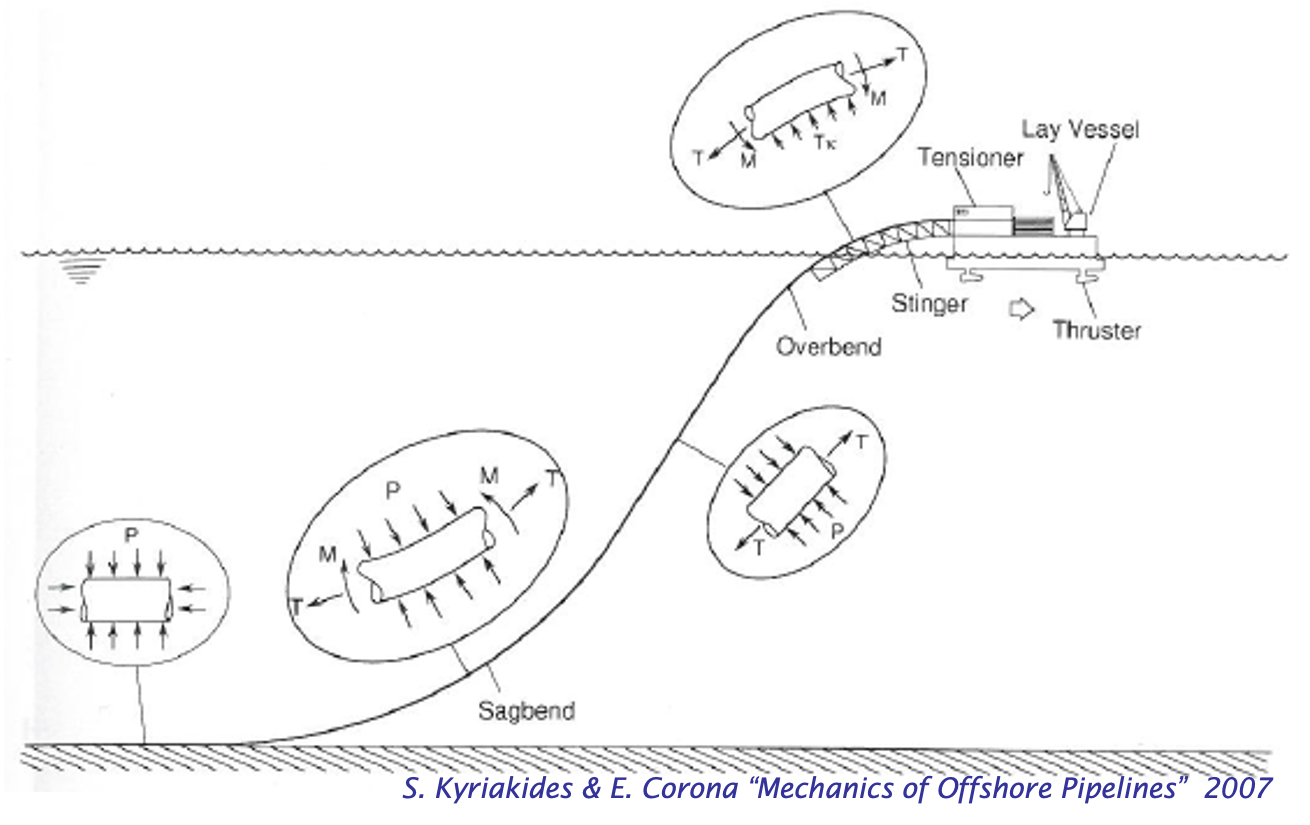
In 2013, I developed a novel FEA methodology that captures the complete life-cycle behavior of concrete coated pipelines from installation through operation. The approach uses ABAQUS’s Concrete Damaged Plasticity (CDP) model, which tracks progressive tensile and compressive failure through separate damage parameters. Unlike simpler models, this captures crack initiation and evolution during installation (shotcrete spraying operations taught me that reality is messier than theory), then models how those cracks affect operational behavior during lateral buckling.
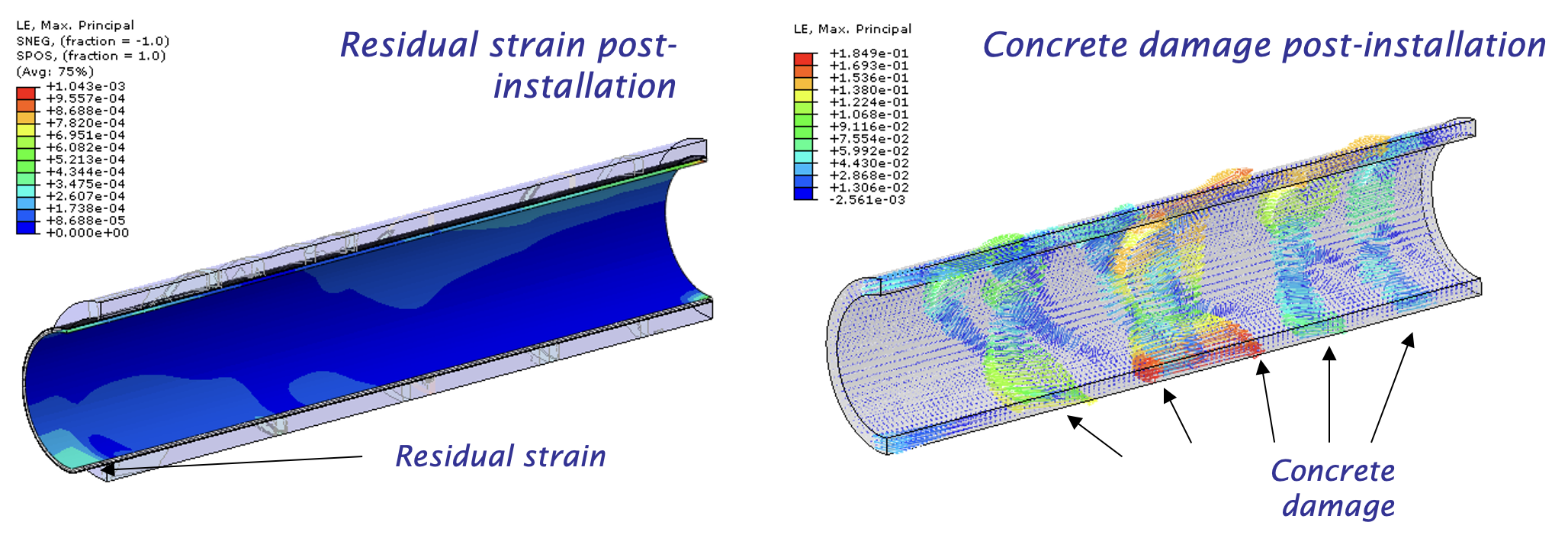
The technical innovation lies in three key advances. First, the model incorporates installation damage explicitly—during pipelay, the concrete experiences 0.2% strain in overbend and 0.15% in sagbend, creating circumferential cracks that permanently alter its stiffness. Traditional methods ignored this. Second, I extracted moment-curvature relationships from detailed 3D FE models and integrated them into global lateral buckling analyses through what I called the Integrated Concrete Stiffness (ICS) model. This eliminated the need for iterative FEA simulations—instead of running 3-month design cycles, we could evaluate design changes in days or weeks. Third, the model accounts for path-dependent behavior: concrete that’s cracked in tension during installation still contributes compressive stiffness during operation when cracks close, but this recovery depends on the loading history.
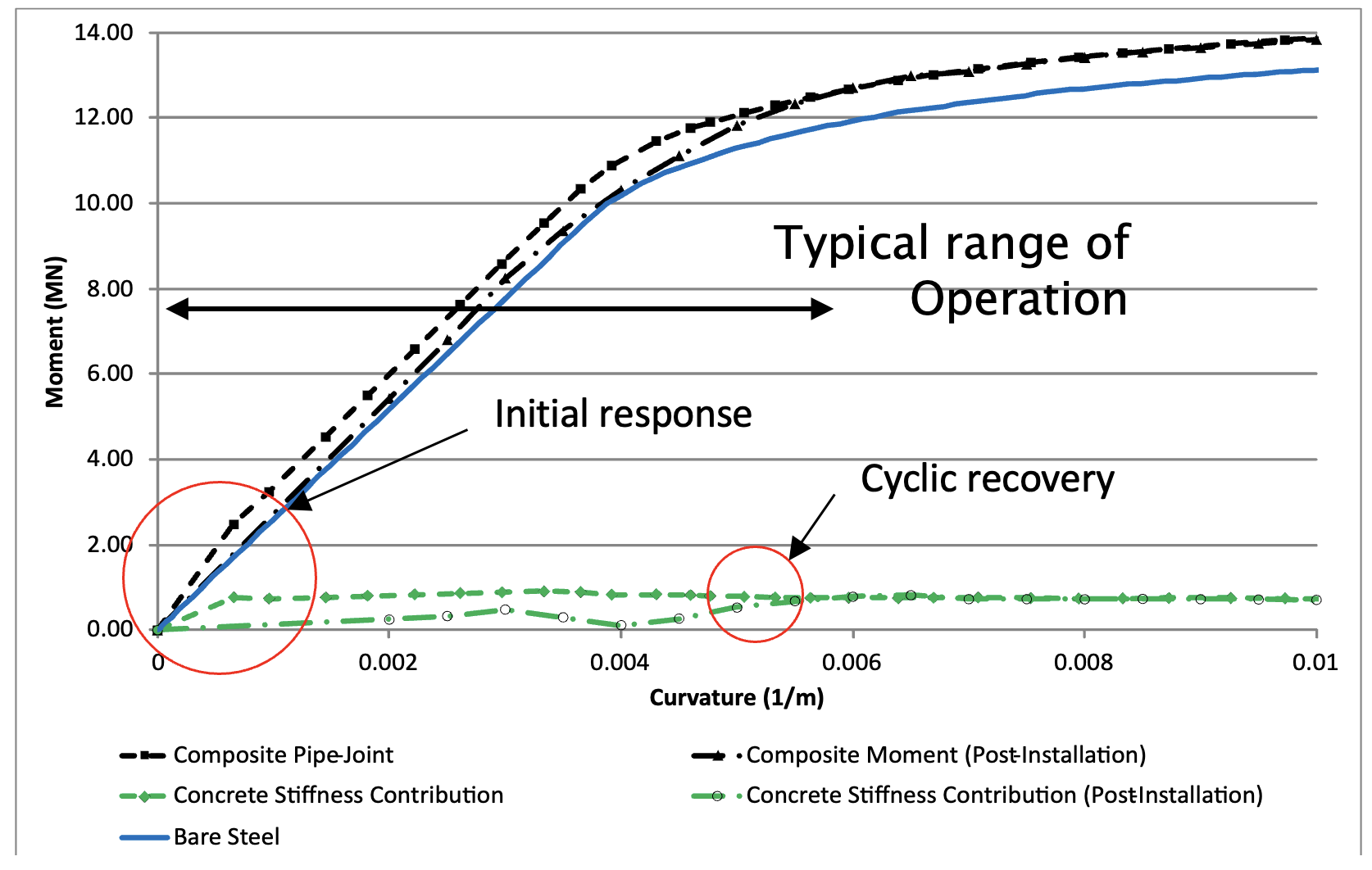
I validated the approach against published bend test data, achieving sound correlation up to 0.33% strain. The model successfully predicted concrete cracking patterns, field joint slippage, and strain concentration factors. For Browse, better prediction of stress concentrations at field joints allowed for larger allowable weld flaws during installation, reducing interruptions for grinding and re-welding. This translated directly to reduced installation costs for the pipeline contractor and lower CAPEX for the project. The methodology represented a material differentiator for WGK—the company had a strong reputation for leveraging technology and R&D investment to improve designs that reduce costs or unlock development of offshore oil and gas fields that would otherwise be considered impossible to access. This approach fell under existing design code provisions for using numerical simulation to reduce conservative assumptions, requiring no changes to standards while delivering tangible commercial value.
This research was presented at the OPT Offshore Technology Conference in 2013.